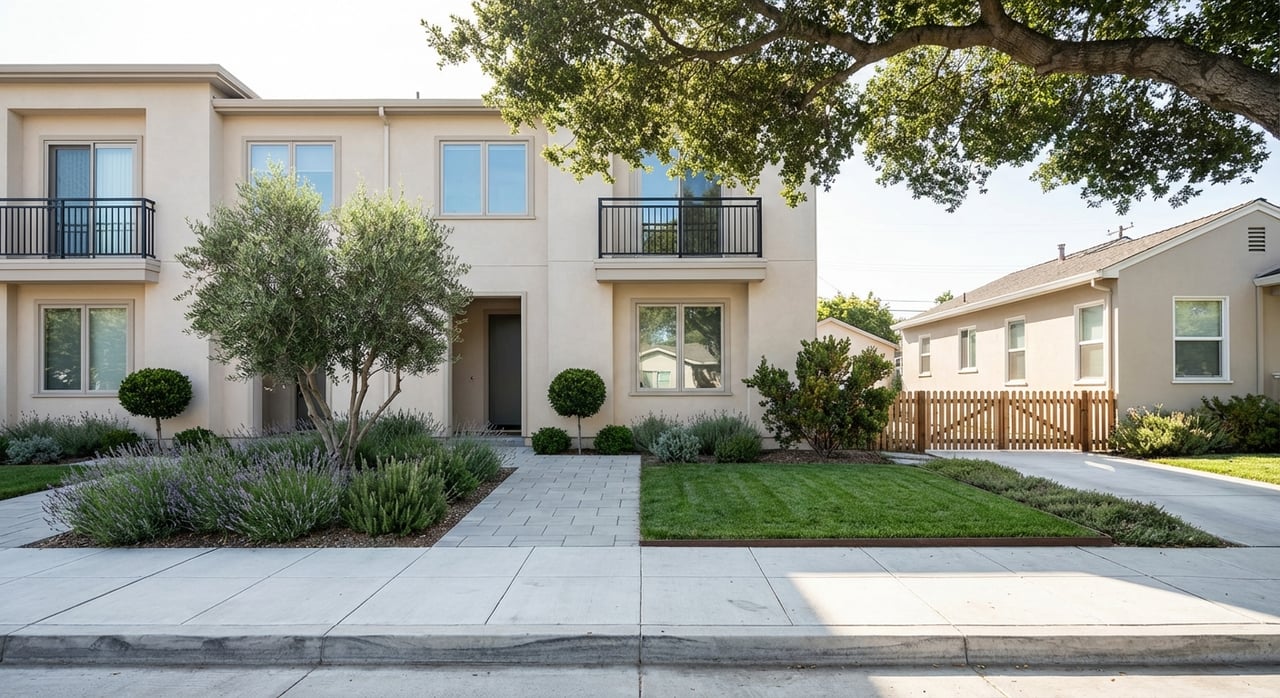
Thinking about buying in Santa Rosa and torn between a townhome and a single-family house? You are not alone. Both options can work well in Wine Country, but they carry different costs, financing rules, and lifestyle tradeoffs. In this guide, you will learn how each choice stacks up on price, monthly expenses, insurance, resale outlook, and local rules that matter in Sonoma County. Let’s dive in.
Quick market snapshot: Santa Rosa
Santa Rosa’s housing market shifts month to month, and different data providers report slightly different medians. Use the figures below as directional context, then plan to verify live MLS data before you write an offer.
| Metric | Santa Rosa figure | Source/date |
|---|---|---|
| Median sale price, single-family (SFR) | $680,000 | Redfin, Jan 2026 |
| Typical condo or townhome asking range | ~$400,000 to $650,000+ | Local listings snapshot, 2026 |
| Price per square foot | Varies by area; mid-hundreds per sq. ft. | Multiple trackers, 2026 |
What this means for you: condos and townhomes often start below many detached homes, though newer or amenity-rich projects can approach SFR pricing in some neighborhoods. Your final comparison should use current, neighborhood-level numbers.
What changes with financing
Condo project approval and “warrantable” status
When you finance a condo or some townhomes, the lender evaluates the entire project, not just your unit. Many loans follow Fannie Mae or Freddie Mac rules, and lenders use project review tools to confirm that a building is eligible. If a project is not “warrantable,” you may face limited loan options or higher costs. Ask your lender to check project eligibility early using resources like Fannie Mae’s Condo Project Manager so you are not surprised later.
- Learn more about project reviews through Fannie Mae’s guidance in the Condo Project Manager overview: Fannie Mae Condo Project Manager.
FHA and VA for condos
If you plan to use FHA financing for a condo, the building must be FHA-approved or qualify for a single-unit approval. Rules cover things like reserves and owner-occupancy rates. Many projects qualify, but not all. You can look up approvals and discuss down payment differences with your lender.
- Check building status on HUD’s page: FHA condo approval lookup.
Closing timelines and HOA documents
HOA homes add a document layer to escrow. California law requires specific HOA disclosures for condos and planned developments. Resale packets should include budgets, reserves, insurance declarations, meeting minutes, and details on any special assessments. If an association is slow to respond, it can delay closing. Build document turnaround time into your timeline and review obligations under the Davis-Stirling Act.
- Get familiar with California HOA disclosure basics here: Davis-Stirling resource.
Monthly cost comparison
Your monthly budget is more than the mortgage. In Sonoma County, HOA fees, maintenance, taxes, and insurance affect total cost of ownership.
HOA fees and what they cover
Condo and townhome HOA dues vary widely by community and amenities. National ranges often fall around $200 to $600 or more per month. In Santa Rosa, actual fees depend on the specific project. Dues may cover exterior maintenance, common-area insurance, landscaping, trash, and sometimes water or sewer. Always read the HOA budget and master policy to see exactly what you still need to insure.
- Typical ranges and how to think about them: HOA fee guide.
- What condo insurance usually covers vs the HOA master policy: Condo insurance overview.
Maintenance planning for houses
With a single-family home, you are responsible for the roof, exterior, yard, fencing, and all systems. A common planning rule is to budget about 1 percent of the home’s value per year for routine maintenance and repairs. That is a heuristic, not a guarantee, and older homes may require more.
- See a simple breakdown of the 1 percent rule: Home maintenance budgeting.
Sonoma County property taxes
California’s base property tax rate is 1.00 percent of assessed value under Proposition 13. Sonoma County parcels also include voter-approved debt service and special district rates, so effective bills often land near about 1.1 to 1.4 percent. The exact rate depends on the parcel. Newer developments can also carry special taxes or Mello-Roos that increase annual costs.
- County tax-rate reference: Sonoma County secured tax rates.
Insurance realities in wildfire country
Wildfire exposure affects insurance availability and price across California, including parts of Sonoma County. Some buyers face limited private-market options, and the California FAIR Plan acts as an insurer of last resort. Plan to get quotes early and include insurance in your affordability check.
- State updates on wildfire and insurance market changes: California Department of Insurance.
For condo owners, you will typically buy an HO-6 policy that covers your unit’s interior, personal property, liability, and loss assessment coverage. The HOA master policy handles common areas and the building exterior, but coverage types vary. Confirm whether the master policy is “bare walls” or “all-in,” and ask about deductibles and any loss-assessment exposure.
- What an HO-6 policy covers and why it matters: Condo insurance guide.
Earthquake coverage is separate for both houses and condos. The California Earthquake Authority offers standardized options. Consider whether your HOA carries earthquake coverage and what the deductible is, then decide if you want your own policy.
- Explore coverage options: California Earthquake Authority.
A simple cost example
Here is a straightforward, hypothetical comparison to illustrate the tradeoff. Exact numbers depend on quotes and the property you choose.
- Townhome example at $600,000: HOA $350 per month, HO-6 insurance $300 per year (about $25 per month). Estimated variable ownership costs for these items total about $375 per month. Exterior and roof are commonly maintained by the HOA, which can reduce surprise repairs, but special assessments are a risk to evaluate.
- Single-family example at $600,000: No HOA. Maintenance set-aside using the 1 percent rule equals about $6,000 per year, or $500 per month. Homeowner’s insurance is usually higher than a condo HO-6, especially in wildfire-prone areas. Get quotes to refine this line item.
Bottom line: Some buyers prefer the cost predictability and lower time commitment of a townhome, while others want full control and a yard even if it means higher maintenance variability.
Resale, liquidity, and lifestyle
Resale patterns and project health
Detached homes often command a premium in many markets because they include land and offer more privacy. Condos and townhomes can appreciate as well, but building health matters. Low reserves, deferred maintenance, or litigation can reduce marketability or limit financing choices, which affects resale.
- See how project eligibility ties to marketability in Fannie Mae’s guidance: Project eligibility overview.
Negotiation power varies by cycle
In some national snapshots, condos have seen larger below-list discounts than other property types. Local results vary by neighborhood and unit condition, but it is useful context if you are price sensitive and open to attached living.
- Market context on where buyers have found discounts: MarketWatch analysis.
Lifestyle and location tradeoffs
If you value privacy, a yard, and a detached garage, a single-family home is hard to beat. If you prefer lower upkeep and a lock-and-leave setup, a townhome or condo may fit better. Many condo and townhome communities sit closer to downtown amenities and transit. Santa Rosa’s CityBus and regional rail connections can make attached living appealing if you want a walkable or car-light routine.
- Local transit overview: Santa Rosa CityBus general info.
Local rules and risk checks
Fire hazard maps and defensible space
CalFire released updated fire hazard severity maps in 2025 that affect parts of Santa Rosa. The city is adopting related vegetation and defensible space requirements and prioritizing neighborhoods for vegetation management. Check whether a property sits in a High or Very High Fire Hazard Severity Zone. These designations can affect insurance, maintenance obligations, and disclosure requirements such as AB 38 inspections.
- Local coverage of the new map rollout: KRCB report on updated fire hazard maps.
Short-term rental rules
If rental income is part of your plan, know that Santa Rosa requires short-term rental operators to register, collect Transient Occupancy Tax, and follow local permit caps. The city caps non-hosted STR permits and may not accept new non-hosted applications. Also confirm HOA restrictions before you count on STR income.
- City STR and TOT FAQs: Santa Rosa STR policy and FAQs.
Taxes and special assessments
All Santa Rosa parcels pay the 1 percent base property tax plus voter-approved debt service. Some newer developments also carry special taxes or Mello-Roos that increase annual bills. Review the parcel’s tax rate area and plan for a supplemental tax bill after closing if the assessed value changes.
- County tax-rate reference: Sonoma County secured tax rates.
Your buyer checklist
Use this list to compare a Santa Rosa townhome to a detached house with confidence.
- Confirm current market numbers by property type and date. Note the source and the month for any median or average used.
- For condos or townhomes, request the HOA resale packet and read the budget, reserve balance, recent and pending special assessments, master insurance declarations, and 12 months of meeting minutes. Clarify whether the master policy is “bare walls” or “all-in,” and the master policy deductible. Start with California’s disclosure framework: Davis-Stirling resource.
- Ask your lender to confirm whether the project is Fannie, Freddie, or FHA warrantable. If not, discuss alternatives and down payment impacts. Reference the project name in your inquiry: Fannie Mae Condo Project Manager and FHA condo lookup.
- Get insurance quotes for both options. Include a condo HO-6 quote and check earthquake coverage through the California Earthquake Authority. For wildfire exposure and market updates, review the California Department of Insurance.
- Verify property taxes for the parcel, including any special assessments or Mello-Roos, and plan for any supplemental bill after closing: Sonoma County secured tax rates.
- If you plan short-term rentals, confirm city permit status, TOT requirements, and HOA rules before relying on projected income: Santa Rosa STR FAQs.
- Compare lifestyle needs like yard size, parking, commute, and proximity to amenities. Use this to shape your resale audience. Keep school boundaries, if relevant, to neutral, factual checks.
- For older buildings or areas with higher fire or seismic risk, order thorough inspections and request any engineer or reserve studies that address capital repairs and retrofits.
Ready to compare real homes and numbers side by side? The Christen Hamilton Team can walk you through live Santa Rosa comps, HOA documents, insurance quotes, and financing paths so your choice fits both your lifestyle and your budget.
FAQs
Is a townhome or a house cheaper monthly in Santa Rosa?
- It depends on the property and location. Townhomes often trade lower than detached homes and shift some costs into HOA dues, while houses avoid HOA fees but require a larger maintenance set-aside and often higher homeowner’s insurance in wildfire areas.
Can I use FHA on a Santa Rosa condo?
- Yes, if the condo project is FHA-approved or qualifies for a single-unit approval. Check building status and discuss down payment and program details with your lender using HUD’s lookup tool.
What do HOA fees usually cover in Santa Rosa condos?
- Dues often fund building exterior upkeep, common-area insurance, landscaping, trash, and amenities. Coverage varies by project, so confirm details in the HOA budget and master policy.
How do Sonoma County property taxes work for buyers?
- California’s base property tax is 1.00 percent of assessed value, plus voter-approved debt service and any special assessments. Effective rates often land near about 1.1 to 1.4 percent in Sonoma County, but each parcel is different.
How does wildfire risk affect homeowners insurance in Santa Rosa?
- Properties in higher fire hazard zones may face limited private-market options and higher premiums. Some buyers use the California FAIR Plan as a fallback. Always get quotes early and include them in your budget.